Arm Lift Surgery (Brachioplasty): When Liposuction Alone Is Not Enough
Brachioplasty is a surgical procedure that removes excess skin and fat from the upper arm — reshaping the contour from the axilla (armpit) to the elbow by excising redundant tissue that cannot be corrected by liposuction or exercise alone. This article is written for adults considering upper arm contouring who want to understand, with clinical accuracy, what surgery can realistically achieve, who is a suitable candidate, and what the recovery involves.
Last medically reviewed by Dr. Sanjog Sharma, MBBS MS DNB — 2026-07-03
Why the Upper Arm Is Different from Other Body Contouring Zones
The upper arm presents a specific anatomical challenge that makes it one of the more demanding areas in body contouring surgery. The skin of the inner upper arm is thin, minimally anchored to underlying structures, and among the first areas to show the effects of significant weight loss, ageing, or hormonal change. Unlike the abdomen or thighs — where the surrounding anatomy provides some structural support — the inner arm skin has limited natural scaffolding, which is why ptosis (drooping) in this area tends to progress faster and respond poorly to non-surgical interventions.
This distinction matters clinically because it determines which patients need what. Fat volume and skin laxity are two separate problems, and they require different tools. A patient with good skin elasticity and primarily fatty fullness in the upper arm may do well with liposuction alone — the skin retracts sufficiently after fat removal to produce a meaningful improvement. But a patient with true skin redundancy — the soft, hangling tissue that folds when the arm is raised — will see little lasting benefit from fat removal if the excess skin is not also excised. Understanding this distinction is the foundation of patient selection for brachioplasty.
Who Is a Good Candidate for Brachioplasty?
The most important assessment in any brachioplasty consultation is the skin pinch test: how much excess skin can be gathered between two fingers when the arm is relaxed and raised? If the answer is significant, and if that tissue lacks the elasticity to retract after fat removal, then skin excision — not liposuction alone — is the appropriate intervention.
| Factor | Suitable for Liposuction Alone | Suitable for Brachioplasty |
|---|---|---|
| Skin elasticity | Good — recoils firmly when pinched | Poor — skin folds or hangs freely |
| Primary concern | Fat volume, fullness | Excess skin with or without fat |
| Weight history | Stable, no major fluctuation | Significant weight loss, post-bariatric, age-related |
| BMI | Generally under 30 | Ideally under 30; higher BMI assessed individually |
| Age | Any (with good skin quality) | More common in 35+ due to reduced skin elasticity |
| Skin tone | All types | All types; scarring risk counselling for Fitzpatrick III–VI |
| Fitness for surgery | Good general health | Good general health, stable weight for ≥6 months |
Patients who have undergone bariatric surgery or body contouring after significant GLP-1 medication weight loss frequently present with arm skin laxity as one of several contouring concerns. In these cases, the upper arm is rarely assessed in isolation — it is part of a broader conversation about sequencing and combining procedures.
Contraindications to elective brachioplasty include active smoking (which significantly impairs wound healing and increases scar complications), poorly controlled diabetes, body weight that is still actively decreasing, and unrealistic expectations about scar position or visibility.
The Brachioplasty Technique: Step by Step
Brachioplasty is not a single operation — it is a family of techniques whose extent is tailored to the degree of skin excess. A patient with mild laxity confined to the axillary region may need only a minimal incision hidden within the armpit fold. A patient with laxity extending toward the elbow requires a longer incision along the medial bicipital groove. Getting the incision design right is the central technical decision, and it is made with the patient standing and arms abducted before surgery begins.
Step 1: Anaesthesia and Patient Positioning
The procedure is performed under general anaesthesia or, in selected cases, deep intravenous sedation combined with local infiltration. The patient lies supine with both arms extended to 90 degrees on arm boards. This position is maintained throughout and allows the surgical team to assess symmetry bilaterally.
Step 2: Pre-operative Marking
This is a critical step that takes place in the holding area, with the patient standing and arms raised. The ellipse of skin to be resected is drawn, accounting for the tension that will be generated at closure. Over-resection causes excessive wound tension, poor healing, and scar widening; under-resection leaves residual laxity. The marking balances these two risks and must factor in the natural arm position — the scar should be concealed along the inner arm when the arm hangs at rest.
Step 3: Infiltration and Dissection
Tumescent solution (saline with dilute adrenaline) is infiltrated along the operative field to reduce intraoperative bleeding. The marked ellipse is incised and the skin-fat unit is elevated and excised. Where there is coexistent fat fullness in adjacent areas — the lateral arm or axillary roll — limited liposuction may be performed at this stage.
Step 4: Deep Fascial Anchoring
This step is what separates a durable result from one that descends over time. The superficial fascia of the arm is sutured to the axillary fascia using strong absorbable or permanent sutures. This transfers closure tension from the skin to a deeper, stronger structure — reducing the mechanical forces acting on the healing scar and improving long-term contour stability.1
Step 5: Layered Wound Closure
The wound is closed in layers: deep fascial layer first, then the subcutaneous layer, followed by an intradermal (buried) suture for the skin surface. This layered approach distributes tension across the repair, reduces scar spread, and minimises surface suture marks. Skin glue or steri-strips are applied externally.
Step 6: Compression Dressing
Immediately post-operatively, a padded compression garment is applied to both arms. Compression reduces post-operative oedema, supports the healing tissues, and helps contour the arm as swelling resolves. It is worn continuously for the first two weeks and during daylight hours for a further four to six weeks.

Pre-operative incision planning is performed with the patient in an upright position — the marking phase is as important as the surgery itself. Photo: Emma Ou / Unsplash
In my practice at Cocoona Centre for Aesthetic Transformation in Dubai, brachioplasty is one of the more frequently requested body contouring procedures among women in their late thirties to fifties — a group in whom both age-related loss of skin elasticity and GLP-1 or dietary weight loss have produced arm skin laxity that exercise alone has not resolved. When I assess these patients at Emirates Hospital, the first question I work through is whether their concern is primarily skin or fat — because the answer determines the procedure. A significant number of patients arrive having heard that liposuction will "tighten" their arms. I explain carefully that liposuction removes volume but relies on skin retraction for the visible result. If that retraction capacity is not there, the skin will simply fold more loosely after fat is removed. The distinction is not subtle once you understand it, but it needs to be made clearly at consultation.
Safety, Risks, and How They Are Managed
Brachioplasty, like all elective surgical procedures, carries risks that must be honestly communicated. The American Society of Plastic Surgeons (ASPS) and the International Society of Aesthetic Plastic Surgery (ISAPS) both include brachioplasty in their published safety guidance frameworks for body contouring surgery.
Scar quality is the most consistently cited patient concern post-operatively, and with reason. The scar is permanent. In most patients it fades to a pale, flat line over twelve to eighteen months, but in a proportion of patients — particularly those with Fitzpatrick III–VI skin types — the scar may become hypertrophic, remain pigmented for longer, or widen with time.2 This is not a failure of technique alone; it reflects individual biological variation in wound healing. Pre-operative counselling must address this clearly, and post-operative scar management — silicone sheeting, sun avoidance, and in some cases intralesional steroid injection — forms part of the recovery protocol.
Wound healing complications — including delayed healing, wound dehiscence (opening), or seroma (fluid collection) — occur in a minority of patients, with rates reported between 5% and 15% in published series.3 Smoking is the single largest modifiable risk factor for poor wound healing; patients are asked to cease smoking for a minimum of four weeks before and four weeks after surgery.
Sensory changes — numbness or altered sensation along the inner arm — are common in the early recovery period. In the majority of patients these resolve within three to six months as nerve endings regenerate. Permanent sensory change is uncommon.
Asymmetry is addressed proactively at the marking stage, but minor differences between sides in final contour or scar position can occur. These are typically within the range of normal biological variation rather than technical error.
Lymphatic disruption near the axilla is a risk that is minimised by limiting dissection in the axillary region and by preserving lymphatic channels where possible. This is a particular consideration in patients who have previously undergone axillary lymph node procedures.
The published literature supports brachioplasty as a safe procedure when performed by trained plastic surgeons in appropriate clinical settings, with patient selection and pre-operative optimisation being the primary determinants of outcome.4
Recovery Timeline After Brachioplasty
Recovery from brachioplasty is more straightforward than recovery from abdominal or lower body contouring, but the arms are engaged in almost every daily activity — making the functional restrictions more immediately apparent to patients.
| Timepoint | What to Expect | Restrictions |
|---|---|---|
| Days 1–3 | Swelling, tightness, bruising along inner arm. Drains (if used) removed by day 2–3. | Arms must not be raised above shoulder height. No driving. |
| Days 4–7 | Swelling peaks. Compression garment worn continuously. First wound review. | No lifting. Light walking permitted. |
| Weeks 1–2 | Bruising fades. Sutures reviewed; intradermal sutures dissolve over 4–6 weeks. | Return to desk-based work possible by day 10–14. |
| Weeks 3–4 | Swelling gradually reducing. Arms feel tight; range of motion improving. | No gym activity. Daytime compression continues. |
| Weeks 5–6 | Significant improvement in contour visible through garment. | Compression garment worn during daytime. Light activity resumes. |
| Months 2–3 | Most swelling resolved. Scar appears pink and slightly raised — this is normal. | Resume most activities. Avoid direct sun on scar. |
| Months 6–12 | Scar progressively softening and flattening. Contour stabilises. | Scar massage recommended. Silicone sheeting if advised. |
| Month 12–18 | Scar reaches mature appearance. Final result assessment. | Normal activity without restriction. |
Patients who have undergone a tummy tuck alongside or prior to arm lift surgery should plan for a combined recovery period in which abdominal restrictions and arm restrictions overlap — usually the first four to six weeks. This is a relevant planning consideration for patients pursuing full post-weight-loss body contouring.
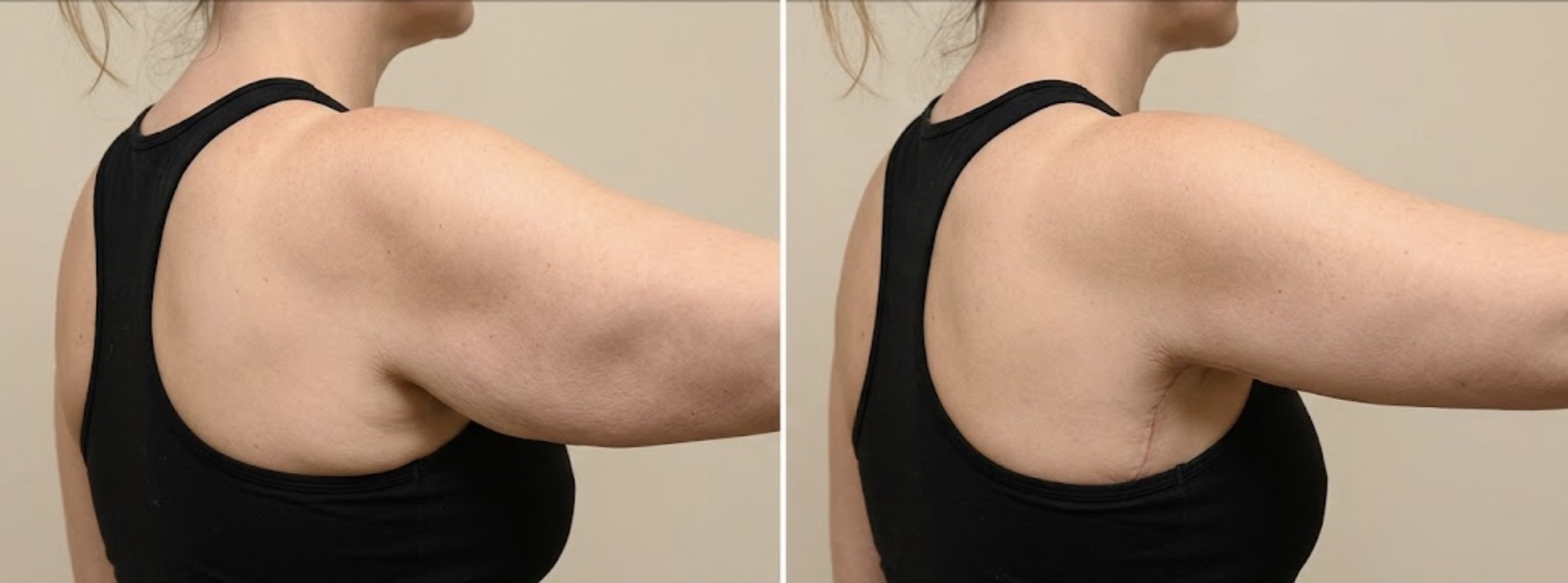
Before and after arm lift surgery: excess skin along the posterior arm is removed and the inner-arm incision heals to a fine line over the following months.

Compression garment application immediately post-operatively is a standard step — the garment supports healing tissue and reduces early swelling during the first critical weeks. Photo: Irshad Pathan / Unsplash
Cost of Brachioplasty in Bengaluru and Dubai
Surgical costs vary based on the extent of skin resection, anaesthesia type and duration, facility fees, and post-operative care requirements. The figures below represent realistic ranges for comprehensive surgical packages; they are not fixed prices, and an exact cost can only be given following an individual assessment.
In Bengaluru: Brachioplasty typically ranges from ₹1,20,000 to ₹2,50,000 for bilateral arm lift. This range reflects variation in case complexity, hospital facility charges at Aesthetica Veda Clinic and comparable facilities, and whether the procedure is combined with others such as liposuction of the lateral arm or axillary roll.
In Dubai: Costs generally range from AED 18,000 to AED 35,000 for bilateral brachioplasty at Cocoona Centre for Aesthetic Transformation, Emirates Hospital, or Dubai London Hospital, inclusive of surgical, anaesthetic, and facility fees. DHA regulatory standards in Dubai require full clinical documentation and pre-operative assessment as part of the cost structure.
Patients should factor in the cost of the compression garment (usually included), post-operative dressings and wound review appointments, and any scar management products recommended during recovery. For patients travelling from abroad for surgery in Bengaluru, accommodation and return travel add to the total cost of the episode.
Clinical Considerations for South Asian and NRI Patients
A significant proportion of my patients at Aesthetica Veda Clinic in Whitefield are Indian expats returning from Dubai, the United Kingdom, or Australia — often people who have lost weight during their time abroad, either through GLP-1 medications or bariatric surgery, and who are now ready for body contouring during a home visit. They arrive with well-researched questions about procedure sequencing, recovery timelines that fit a fixed visit window, and an awareness of the standards they expect.
For South Asian patients specifically, there are two clinical factors that I address explicitly in every brachioplasty consultation. The first is skin type. Patients with Fitzpatrick III to VI skin — the range that encompasses most South Indian, North Indian, and Pakistani patients — have a higher baseline tendency toward post-inflammatory hyperpigmentation and hypertrophic scar formation at surgical incision lines than patients with lighter skin tones.5 This does not make brachioplasty inadvisable; it means that scar placement, suture technique, and post-operative scar management require additional attention and planning. I use a meticulous layered closure technique in all patients, and I am more proactive with silicone sheeting and pigmentation management in darker-skinned patients from the outset.
The second factor is body composition. South Asian patients tend to present with denser subcutaneous fat in the upper arm compared with Western European patients of similar BMI — a pattern that has been documented in body composition research and that I observe consistently in clinical practice. Where there is significant fat volume alongside skin laxity, I will typically plan for limited liposuction as part of the brachioplasty procedure rather than as a separate stage.
Patients in Bengaluru ask me the same questions I hear in Dubai — and the surgical approach is identical. I apply the same protocols at Aesthetica Veda in Whitefield as I do at Cocoona or Emirates Hospital in Dubai. The difference is logistics, not standard of care.
Brachioplasty in the Context of Combined Body Contouring
Brachioplasty is rarely the only procedure a patient needs when addressing the consequences of major weight loss. Upper arm laxity typically coexists with skin excess in the abdomen, thighs, and breasts — and the question of whether to address these in a single operative session or staged across multiple operations is one of the most important strategic decisions in post-weight-loss surgical planning.
The general principle is that combined procedures are appropriate when the total operative time remains within safe limits (typically under five to six hours), the patient is fit for extended anaesthesia, and the combined blood loss and physiological stress of the procedures is acceptable. Combining brachioplasty with a tummy tuck or abdominoplasty — two of the most frequently co-requested procedures in post-weight-loss patients — is common and well-documented in the surgical literature.6 Combining it with breast surgery or thigh lift adds further anaesthesia time and requires careful pre-operative planning.
Patients who have undergone a full mommy makeover combining breast and abdominal procedures sometimes return six to twelve months later for brachioplasty as a second-stage procedure, having recovered fully from the primary operation. This staged approach is often the safer choice when the combined operative burden would otherwise be too great.
For patients interested in upper arm contouring without skin laxity — those who have maintained good skin quality and simply want enhanced muscular definition — high-definition liposuction techniques may be a more appropriate option, as these target fat selectively while preserving and accentuating the underlying muscle anatomy.
Frequently Asked Questions
What is the difference between an arm lift and liposuction for the upper arms?
Liposuction removes excess fat but cannot tighten skin. An arm lift (brachioplasty) removes surplus skin and fat, making it the appropriate choice when skin laxity — not fat volume alone — is the primary concern. Many patients need both components addressed together.
Am I a good candidate for brachioplasty?
Good candidates are adults with stable weight who have excess skin on the upper arms that does not respond to exercise. Significant skin laxity after weight loss, post-bariatric surgery, or age-related changes are common indications. A BMI under 30 is generally preferred for elective surgery.
How long is recovery after arm lift surgery?
Most patients return to desk-based work within ten to fourteen days. Swelling and tightness persist for four to six weeks. Strenuous arm activity and lifting are restricted for six weeks. Final scar maturation takes twelve to eighteen months.
What does brachioplasty cost in Bengaluru and Dubai?
In Bengaluru, brachioplasty typically ranges from ₹1,20,000 to ₹2,50,000 depending on the extent of resection and anaesthesia fees. In Dubai, costs generally range from AED 18,000 to AED 35,000. An exact figure requires an individual surgical assessment and consultation.
Will the scar from an arm lift be visible?
The scar runs along the inner aspect of the upper arm and is designed to be concealed when the arm is held at the side. It is visible when the arm is raised. Scars mature and fade over twelve to eighteen months; their final appearance depends on individual healing, skin type, and scar care.
Is brachioplasty safe for patients with South Asian or darker skin tones?
The procedure is safe for all skin types, but patients with Fitzpatrick III–VI skin — common in South Asian populations — carry a higher baseline risk of hypertrophic scarring or hyperpigmentation at the incision line. Pre-operative counselling, meticulous closure technique, and post-operative scar management protocols are adjusted accordingly.
Can an arm lift be combined with other body contouring procedures?
Yes. Brachioplasty is frequently combined with procedures such as a tummy tuck, thigh lift, or breast surgery in post-weight-loss patients. Combining procedures extends operating time and anaesthesia duration, so patient fitness and surgical risk are carefully assessed before planning combined cases.
How soon after weight loss can I have a brachioplasty?
Surgeons generally advise waiting until your weight has been stable for at least six to twelve months before proceeding. Operating during active weight loss produces suboptimal results, as further weight change will alter skin tension and contour after surgery.
Key Points
- Brachioplasty removes excess upper-arm skin and fat that liposuction alone cannot correct.
- It best suits patients with significant skin laxity, often after weight loss, at a stable weight.
- The scar runs along the inner arm; its length depends on how much skin is removed.
- Recovery involves compression garments and a graded return to activity over several weeks.
- Cost varies with extent and location; an in-person consultation is needed for an accurate quote.
References
-
Hurwitz DJ, Agha-Mohammadi S. Postbariatric surgery breast and body contouring. Plastic and Reconstructive Surgery. 2008;121(1):1–12. https://doi.org/10.1097/01.prs.0000294700.03719.8b1
-
Kitzinger HB, Cakl T, Wenger R, Forstner R, Pöll G, Lumenta DB. Prospective study on combined laparoscopic sleeve gastrectomy and secondary body-contouring procedures. Journal of Plastic, Reconstructive & Aesthetic Surgery. 2013;66(6):840–848. https://doi.org/10.1016/j.bjps.2013.01.0362
-
Shermak MA, Rotellini-Coltvet LA, Chang D. Seroma development following body contouring surgery for massive weight loss: patient risk factors and treatment strategies. Plastic and Reconstructive Surgery. 2008;122(1):280–288. https://doi.org/10.1097/PRS.0b013e31817742bb3
-
El Khatib HA. Classification of brachial ptosis: strategy for treatment. Plastic and Reconstructive Surgery. 2007;119(4):1337–1342. https://doi.org/10.1097/01.prs.0000254401.99861.ce4
-
Dashore S, Chouhan K. Hypertrophic scars and keloids: a review of therapeutic approaches and their outcomes in darker skin tones. Aesthetic Plastic Surgery. 2021;45(3):1134–1145. https://doi.org/10.1007/s00266-020-02077-55
-
Gusenoff JA, Rubin JP. Plastic surgery after weight loss: current concepts in massive weight loss surgery. Aesthetic Surgery Journal. 2008;28(6):655–670. https://doi.org/10.1177/1090820X083257686