Safe Brazilian Butt Lift: How I Follow the Multi-Society Task Force Guidelines
A Brazilian Butt Lift (BBL) is a fat transfer procedure that harvests fat via liposuction from donor areas — typically the abdomen, flanks, and thighs — and reinjects it into the buttocks to enhance volume and shape. This article is written for patients considering BBL surgery who want to understand not just what the procedure involves, but how safety protocols have transformed surgical practice and what a guideline-compliant approach looks like in practical terms.
Last medically reviewed by Dr. Sanjog Sharma, MBBS MS DNB — 2026-08-08
For several years, BBL carried the highest reported mortality rate of any elective cosmetic procedure — an alarming fact that prompted the formation of a Multi-Society Task Force and a fundamental change in how the procedure is performed worldwide.1 Understanding those changes is not optional background reading. It is the foundation on which every safe BBL consultation should be built.
Why BBL Had a Fatality Problem — and What Changed
The mechanism behind BBL-related deaths was identified with unusual clarity: fat injected into or near the deep gluteal musculature could enter the inferior and superior gluteal veins, travel to the lungs, and cause fatal pulmonary fat embolism. An autopsy study published in Aesthetic Surgery Journal confirmed this pathway and found that the risk was highest when large cannulae were directed deep into the gluteal muscle or into the deep gluteal space beneath it.2
In 2018, the American Society of Plastic Surgeons (ASPS), the American Society for Aesthetic Plastic Surgery (ASAPS), the International Society of Aesthetic Plastic Surgery (ISAPS), and several other major societies jointly convened the Multi-Society Task Force for Safety in Gluteal Fat Grafting. Their guidelines issued a clear directive: fat must be injected exclusively into the subcutaneous layer of the buttocks. No intramuscular or submuscular injection is acceptable.1
A 2020 follow-up survey published in Plastic and Reconstructive Surgery demonstrated that adoption of these guidelines was associated with a measurable reduction in reported fatalities — from an estimated 1-in-3,000 to figures closer to 1-in-14,000 and improving further as compliance increased.3 The 2023 updated task force position paper reinforced these findings and added specific guidance on cannula diameter, injection technique, and the adjunctive use of real-time ultrasound in high-risk zones.4
The lesson is straightforward: the procedure itself is not inherently more dangerous than other fat grafting operations. The danger was technique-dependent, and correcting technique has corrected most of the risk.
Who Is a Good Candidate for BBL Surgery
Not every patient who wants a larger or shapelier buttock is a suitable candidate for fat transfer. Candidacy assessment is the first safety gate.
| Criterion | Suitable | Not Suitable |
|---|---|---|
| BMI | 22–35 | Under 20 (insufficient donor fat) |
| Donor fat availability | Adequate fat in abdomen, flanks, thighs | Very lean physique with minimal harvestable fat |
| Skin quality | Moderate laxity acceptable | Severe ptosis may need implant instead |
| Smoking status | Non-smoker or stopped ≥4 weeks | Active smoker — significantly impairs fat survival |
| Anticoagulation | Off anticoagulants ≥2 weeks | On anticoagulants — bleeding risk at harvest and graft sites |
| BMI trajectory | Stable weight for ≥6 months | Actively losing weight — graft resorbs disproportionately |
| Medical fitness | ASA I or II | Uncontrolled diabetes, coagulopathy, active malignancy |
| Realistic expectations | Understands fat resorption (~20–40%) | Expecting volumetric certainty or implant-equivalent firmness |
Patients who have lost significant weight — whether after bariatric surgery or GLP-1 medication — present specific considerations. The body contouring surgery guide covers how post-weight-loss tissue changes affect procedure planning, and these principles apply directly to fat harvest quality in post-GLP-1 BBL candidates.
In my practice at Cocoona Centre for Aesthetic Transformation in Dubai, I see a significant number of patients who present having lost 15–30 kg on semaglutide or tirzepatide. Their donor fat quality is often different — more fibrous stroma, lower adipocyte density in some zones — and I counsel them carefully about realistic volume retention expectations before any surgical plan is made.
Step-by-Step: How a Guideline-Compliant BBL Is Performed
Step 1: Pre-operative Planning and Marking
The patient is assessed and marked while standing. I identify the donor zones — abdomen, flanks, lower back, outer thighs, or inner thighs depending on available fat distribution — and map the buttock injection zones using surface anatomy. The deep gluteal space, which lies beneath the gluteus maximus, is explicitly excluded as a target zone. Marking takes place the morning of surgery, not the night before, to ensure accurate positional reference.
Step 2: Anaesthesia and Patient Positioning
BBL is performed under general anaesthesia in the prone (face-down) or lateral decubitus position for the injection phase. Positioning must allow the surgeon to work safely on the buttocks without awkward ergonomics — poor positioning has been identified as a contributing factor in technique errors.
Step 3: Tumescent Infiltration
Dilute tumescent solution — typically 0.05% lidocaine with 1:1,000,000 adrenaline in normal saline — is infiltrated into all donor sites. This reduces intraoperative blood loss, facilitates hydrodissection of fat planes, and improves fat-cell viability at harvest.
Step 4: Fat Harvesting via Liposuction
Fat is harvested using 3–4 mm blunt-tipped cannulae connected to a low-pressure suction system. Excessive negative pressure damages adipocytes and reduces graft viability. I harvest from multiple donor zones to achieve the planned volume while keeping any single donor site within safe liposuction volume limits per the recommendations of the ASPS. For patients who want to understand the differences between liposuction techniques, the comparison of VASER liposuction vs traditional liposuction is relevant here — VASER-assisted harvest is an option in some patients but requires careful selection.
Step 5: Fat Processing
Harvested lipoaspirate is processed immediately. I use closed-system centrifugation at approximately 1,200–3,000 rpm for three minutes, which separates purified fat from blood, oil, and tumescent fluid. The middle yellow fat layer is retained; the infranatant and supranatant fractions are discarded. Some surgeons prefer filtration and washing — both are acceptable per task force guidance, provided the fat is handled in a closed, sterile system.
Step 6: Subcutaneous-Only Fat Injection
This is the critical safety step. Purified fat is loaded into 10 mL syringes and injected using blunt, 4 mm cannulae. All injections are made into the subcutaneous fat layer only. The cannula is directed superficially and laterally, away from the deep gluteal musculature. I use a fanning technique with continuous movement of the cannula — no bolus injection into a single point. Each pass deposits small aliquots of 1–2 mL, building volume incrementally across multiple planes within the subcutaneous tissue.
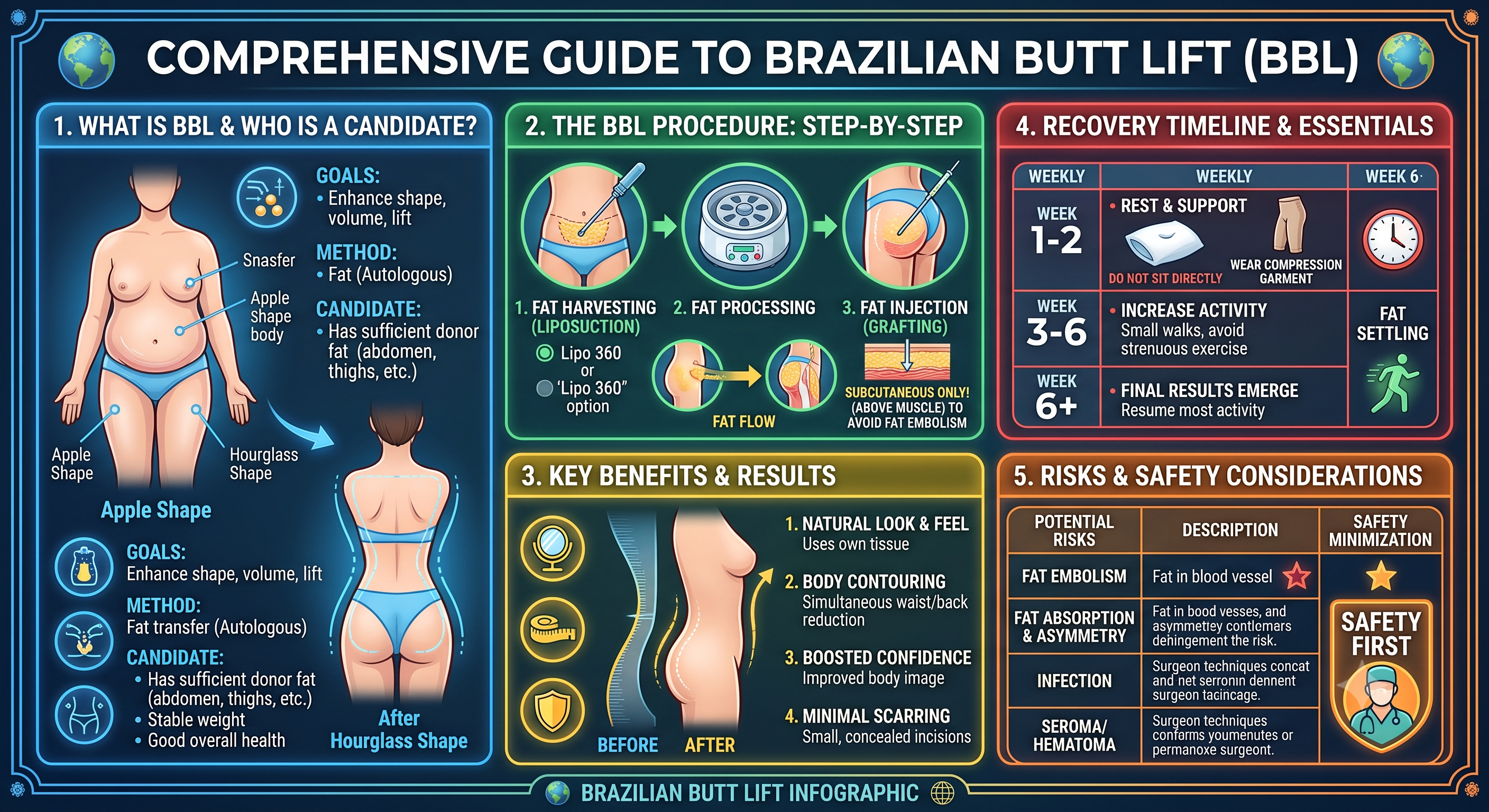
Pre-operative markings define safe subcutaneous injection territories and explicitly exclude the deep gluteal space from the injection plan.
Step 7: Ultrasound Guidance in High-Risk Zones
For patients with a thin subcutaneous fat layer over the inferior buttock — where the margin between subcutaneous tissue and the gluteal vessels is narrow — I use real-time intraoperative ultrasound to confirm cannula position before injection. This is not required in every patient but is a valuable adjunct in patients with less natural soft-tissue buffer. The 2023 task force update specifically endorses ultrasound guidance as a risk-reduction tool.4
Step 8: Wound Closure and Compression
Liposuction incisions are closed with absorbable sutures or Steri-Strips. A multilayer compression garment is applied to all donor sites immediately. A specialised BBL post-operative pillow is provided to the patient to avoid direct buttock pressure during sitting.
Safety, Risks, and How Guidelines Mitigate Them
The ASPS and ISAPS guidelines frame BBL risk in three categories: anaesthetic risk, liposuction-related risk, and fat embolism risk. Of these, fat embolism risk is uniquely relevant to BBL and is mitigated almost entirely by technique.
Fat embolism — the historically fatal complication — occurs when fat enters the gluteal venous system. The multi-society task force's cadaveric and imaging studies showed that the inferior gluteal vein runs in a predictable location within the deep gluteal space and can be inadvertently entered when cannulae are directed deep or medially. Subcutaneous-only technique eliminates this risk pathway because the gluteal veins do not traverse the superficial fat layer.2
Seroma at donor sites is managed with compression garments worn for six to eight weeks. Contour irregularities — waviness or asymmetry — are managed with touch-up liposuction at three to six months if required. Fat necrosis, presenting as firmness or small cysts within the graft, is uncommon with correctly processed and injected fat. Infection risk is reduced by prophylactic antibiotics and sterile technique throughout.
Patients considering multiple body contouring procedures at the same sitting — for example, BBL combined with a tummy tuck — should understand that combining procedures significantly increases operative time, blood loss risk, and recovery complexity. I discuss the considerations involved in mommy makeover surgery and combined procedures with patients who raise this question, and I apply the same conservative staging principles at both my Dubai and Bengaluru practices.
Recovery Timeline After BBL
| Timeframe | What to Expect |
|---|---|
| Days 1–3 | Soreness at donor and recipient sites; compression garment worn continuously; limited mobility; oral analgesia |
| Week 1 | Drain removal if placed; suture check; significant bruising and swelling at donor sites; avoid sitting directly on buttocks |
| Weeks 2–3 | Swelling reducing; BBL pillow used for any sitting; light walking encouraged; no strenuous lower-body exercise |
| Weeks 4–6 | Return to desk work; compression garment continues; buttock contour beginning to soften and settle |
| 3 months | ~60–80% of final fat retention established; review appointment to assess volume and symmetry |
| 6 months | Final result assessment; touch-up liposuction at donor sites considered if required |
The single most important post-operative instruction is pressure avoidance. Sustained direct pressure on the grafted buttock compresses the neovascularising fat, increases resorption, and can cause localised fat necrosis. A purpose-made BBL pillow — which transfers weight to the thighs — is non-negotiable for the first three weeks.
Compression garments at donor sites and a BBL support pillow are used from the first post-operative day to protect the fat graft and optimise retention.
First-Person Clinical Perspective
Over ten years of performing gluteal fat grafting across South Asian, Middle Eastern, and Western patient populations in Dubai, the pattern I see most consistently is that safety outcomes are entirely predictable when technique is controlled. The patients who have complications — seromas, asymmetry, uneven fat retention — almost always trace back to a single identifiable deviation from protocol: too rapid an injection rate, too large a bolus per pass, or a cannula directed too deep. The Multi-Society Task Force guidelines did not invent a new operation; they codified what careful surgeons were already doing and gave the entire specialty a standard to measure against.
When I assess patients for BBL at Emirates Hospital in Dubai, the conversation about safety is not a formality. I show patients the anatomy — specifically, where the gluteal veins run relative to the subcutaneous plane — and explain exactly why subcutaneous-only injection is not just a preference but a structural safety requirement. Patients who understand the anatomy are better partners in their own care: they follow pressure-avoidance instructions more rigorously, they understand why fat retention varies, and they have realistic expectations about the final volume.
Patients in Bengaluru ask me the same questions I hear in Dubai — and the surgical approach is identical. I apply the same protocols at Aesthetica Veda Clinic in Whitefield as I do at Cocoona Centre for Aesthetic Transformation or Emirates Hospital in Dubai. The task force guidelines are international standards; geography does not change anatomy or physics.
Cost of BBL Surgery in Bengaluru and Dubai
Cost is a legitimate part of decision-making and should be discussed honestly.
Bengaluru (Aesthetica Veda Clinic, Whitefield): ₹2,00,000 – ₹4,50,000, depending on the volume of fat transferred, number of donor sites liposuctioned, facility fees, and anaesthesia charges.
Dubai (Cocoona Centre for Aesthetic Transformation / Emirates Hospital): AED 22,000 – AED 45,000, depending on the same variables plus facility tier.
These are indicative ranges. An exact cost requires an in-person consultation to assess donor fat availability, planned volume, and surgical duration. The cheapest BBL is not the safest BBL — facility standards, equipment quality, and surgical experience are direct cost drivers.
A significant proportion of my Bengaluru patients are Indian expats returning from the UAE, UK, or Australia for elective surgery. They often compare quotes between Dubai and Bengaluru and find that equivalent surgical quality is accessible at lower total cost — including travel — when surgery is planned during a home visit. The medical tourism considerations for Indian expats article covers this comparison in detail.
For patients whose primary concern is donor-site contouring alongside buttock augmentation, it is worth reading the liposuction vs tummy tuck decision guide to understand which anterior-body procedure best complements a BBL plan.
NRI and South Asian Patient Considerations
South Asian patients presenting for BBL have several clinically relevant characteristics that affect planning:
Fat distribution: South Asian body habitus commonly features higher visceral fat with relatively less subcutaneous fat in the classic BBL donor zones (lateral flanks, outer thighs). Preoperative fat mapping is important to ensure sufficient harvestable volume.
Skin characteristics: Fitzpatrick III–V skin types have higher melanocyte activity and a greater tendency toward post-inflammatory hyperpigmentation at incision sites and areas of bruising. I counsel patients on scar site selection and post-operative sun protection accordingly.
Keloid and hypertrophic scar tendency: Incision sites for liposuction in BBL are small (3–4 mm), but patients with a personal or family history of keloid formation require pre-operative counselling and may benefit from adjunctive scar management post-operatively.
Cultural and aesthetic preferences: South Asian aesthetic ideals for gluteal shape often emphasise projection and upper-pole fullness rather than maximum lateral width. Injection mapping is adjusted to reflect individual aesthetic goals rather than applying a single template.
Key Points
- BBL-related mortality was linked to intramuscular and submuscular fat injection; the Multi-Society Task Force mandate of subcutaneous-only injection has substantially reduced this risk.
- Blunt cannulae, continuous movement technique, and small aliquot injection (1–2 mL per pass) are the technical foundations of safe gluteal fat grafting.
- Real-time intraoperative ultrasound is a validated adjunct for confirming subcutaneous cannula placement in patients with limited soft-tissue buffer.
- Fat retention after BBL ranges from 60–80% of injected volume; results are assessed at three to six months.
- Post-operative BBL pillow use for three weeks is a non-negotiable recovery requirement, not optional guidance.
- Guideline-compliant BBL is available in Bengaluru at the same technical standard applied in Dubai — the anatomy and the safety protocols are identical regardless of location.
Frequently Asked Questions
What makes Brazilian Butt Lift surgery dangerous, and how is the risk reduced?
The primary danger is fat embolism caused by inadvertent injection into or near the deep gluteal veins. Risk is reduced by injecting fat only into the subcutaneous layer, never intramuscularly, using blunt cannulae and ultrasound guidance where appropriate. Following Multi-Society Task Force protocols has been shown to significantly lower fatality rates.
Is BBL surgery safe in India?
BBL surgery is safe in India when performed by a trained plastic surgeon using evidence-based protocols in an accredited facility. The Multi-Society Task Force guidelines apply regardless of geography — the same subcutaneous-only injection technique used in Dubai is applied at Aesthetica Veda Clinic in Bengaluru.
How much does a Brazilian Butt Lift cost in Bengaluru?
BBL surgery in Bengaluru typically ranges from ₹2,00,000 to ₹4,50,000 depending on the volume of fat transferred, the number of donor sites, and the facility. An exact cost requires an in-person consultation to assess individual anatomy and surgical complexity.
How long does BBL recovery take?
Most patients resume light daily activities within two to three weeks. Direct sitting pressure on the buttocks must be avoided for three weeks using a BBL pillow. Full softening of the result and final fat retention is assessed at three to six months.
How much fat survives after a BBL?
Fat retention after BBL typically ranges from 60% to 80% of the injected volume, depending on injection technique, post-operative pressure avoidance, and individual factors such as vascularity and metabolic status. The surgeon typically overcorrects to account for expected resorption.
Can I have a BBL if I am thin or have limited donor fat?
Limited donor fat is a genuine constraint for BBL candidacy. Patients with very low body fat may not yield sufficient graftable volume. In such cases, a combination approach using a smaller fat transfer with implants, or a staged procedure after modest weight gain, can be considered.
What is the Multi-Society Task Force for Safety in Gluteal Fat Grafting?
It is a joint expert panel convened by ASPS, ASAPS, ISAPS, and other major plastic surgery societies that published evidence-based safety guidelines for BBL in 2018 and updated them in 2023. The core mandate is subcutaneous-only fat injection to eliminate the risk of fatal fat embolism.
References
-
Mofid MM, Teitelbaum S, Suissa D, et al. Report on Mortality from Gluteal Fat Grafting: Recommendations from the ASERF Task Force. Aesthetic Surgery Journal. 2017;37(7):796–806. https://doi.org/10.1093/asj/sjx004
-
Cárdenas-Camarena L, Durán H, Robles-Cervantes JA, et al. Fatal Complications in Buttock Augmentation with Fat Injections: The Pathophysiology and Anatomical Study of this Complication. Aesthetic Surgery Journal. 2015;35(7):809–816. https://doi.org/10.1093/asj/sjv070
-
Pazmiño P, Saldanha OR. The Brazilian Butt Lift — Current Practice, Safety Update, and Future Directions. Plastic and Reconstructive Surgery Global Open. 2020;8(10):e3151. https://doi.org/10.1097/GOX.0000000000003151
-
Villanueva NL, Del Vecchio DA, Afrooz PN, Carboy JA, Rohrich RJ. Staying Safe During Gluteal Fat Transplantation: Updated Multi-Society Task Force Position Statement. Plastic and Reconstructive Surgery. 2023;151(6):1387–1396. https://doi.org/10.1097/PRS.0000000000010221
-
Sinno S, Mehta K, Reavey PL, Simmons C, Stuzin JM. Current Trends in Gluteal Augmentation: A National Survey of Plastic Surgeons. Annals of Plastic Surgery. 2016;77(6):670–674. https://doi.org/10.1097/SAP.0000000000000814