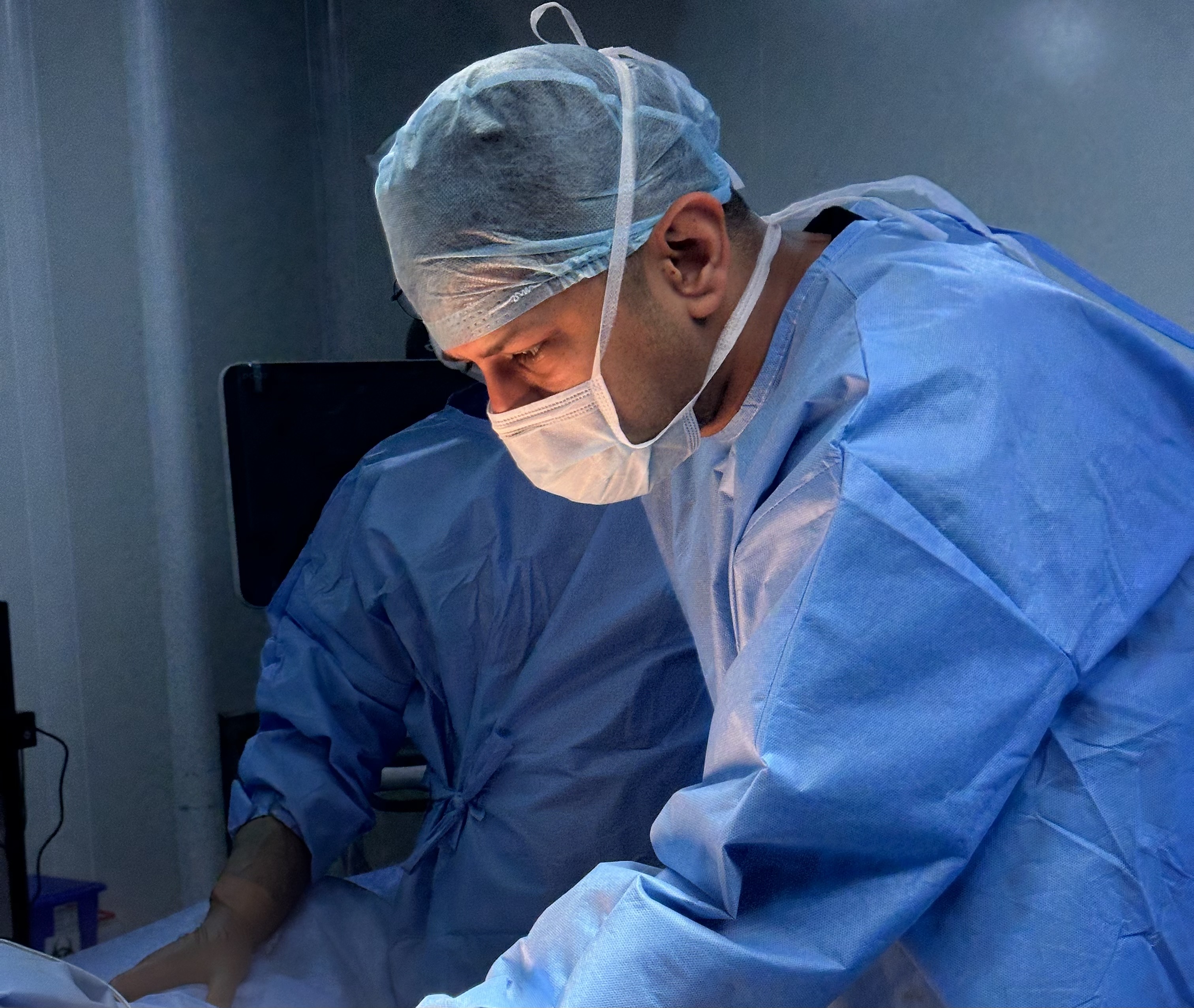
A compression garment is a medical-grade elastic garment worn over an operated area after body contouring surgery — it applies graded external pressure that limits fluid accumulation in the surgical space and holds the skin against the underlying tissue while the two re-adhere. It is prescribed for essentially every patient who has had liposuction, abdominoplasty, arm or thigh lift, or post-bariatric contouring, and the foam that sits beneath it is what makes that pressure even rather than patchy.
Last medically reviewed by Dr. Sanjog Sharma, MBBS MS DNB — 23 August 2026
Compression is the part of body contouring that patients underestimate most. The operating time is a few hours; the garment is worn for six to twelve weeks. Much of the difference between a smooth result and a lumpy one is decided in that period, not on the table.
What Compression Garments and Foam Do After Liposuction and Abdominoplasty
Liposuction creates a lattice of tunnels through the subcutaneous fat and leaves a potential space between the skin flap and the deep fascia. Abdominoplasty creates a much larger single space by elevating the skin off the abdominal wall. In both cases the body fills that space with fluid before it seals it. Compression does three measurable things.
First, it reduces dead space. Sustained external pressure holds the skin envelope down against the deeper layer so that fibrin bridging and adherence occur across a thin interface rather than across a fluid-filled cavity. This is the mechanism most directly linked to lower rates of seroma, the collection of straw-coloured fluid that is the most common complication after abdominoplasty and large-volume liposuction.1,2
Second, it manages oedema. After tumescent infiltration, a substantial volume of fluid remains in the tissue and drains over the first several days. Graded compression supports lymphatic and venous return and limits the dependent swelling that otherwise makes the abdomen, flanks and thighs feel tight and heavy in week one.
Third, it shapes. The skin over a freshly suctioned area is mobile and swollen, and it will consolidate in whatever position it is held. Foam is what determines that position. A garment alone presses hardest over prominences and least over hollows, which exaggerates existing irregularity. A sheet of open-cell foam, or a moulded board over the abdomen, spreads that load across the whole surface.
 First-stage compression garment with an open-cell foam layer, used across the abdomen and flanks.
Compression does not remove fat, tighten skin beyond what surgery achieved, or accelerate healing beyond biological limits. It protects a result that has already been created. Patients considering surgery will find the wider context useful in our overview of body contouring surgery options and recovery.
Who Needs Compression After Body Contouring — Candidacy and Garment Selection
Almost every body contouring patient is a candidate for compression, but the type, pressure and duration vary considerably. The variables that matter are the size of the undermined space, the quality of the skin, and the patient's medical background.
| Patient or procedure | Typical first-stage compression | Foam or board | Usual total duration |
|---|---|---|---|
| Small-volume liposuction, single area | Light to moderate garment | Foam over treated zone | 4–6 weeks |
| Large-volume or 360-degree liposuction | Full-torso graded garment | Full foam sheets, flank pads | 8–12 weeks |
| Abdominoplasty | Abdominal binder then garment | Abdominal board over the flap | 8–12 weeks |
| Post-bariatric or massive weight loss contouring | Full-length graded garment | Extensive foam, seam protection | 10–12 weeks |
| Arm or thigh lift | Sleeve or thigh garment | Limited foam, seam padding only | 6–8 weeks |
| Gynaecomastia surgery | Chest compression vest | Chest foam pad | 4–6 weeks |
Compression is modified rather than omitted in a few situations. Patients with peripheral arterial disease, poorly controlled diabetes with neuropathy, or fragile atrophic skin need lower pressure and closer skin surveillance, because they may not feel a garment that is doing damage. Patients with significant respiratory limitation should not have circumferential abdominal or chest compression applied at a pressure that restricts excursion.
Skin type also influences the plan. In South Asian, Middle Eastern and African patients — Fitzpatrick phototypes III to VI — the risk of post-inflammatory hyperpigmentation and hypertrophic scarring is meaningfully higher, and a garment seam that repeatedly rubs an incision line can leave both a pigmented mark and a thickened scar.3 This is a practical argument for foam over the incision rather than fabric directly against it in the first weeks.
Types of Compression Garments and Foam Used in Body Contouring
First-stage and second-stage garments
First-stage garments are firmer, usually fasten with hooks or a zip so they can be applied without pulling over swollen tissue, and are designed to be worn continuously. Second-stage garments are lighter, step-in or pull-on, and are intended for the phase when swelling has largely settled but the tissue still benefits from support. Moving from stage one to stage two is a clinical decision, not a calendar one.
Abdominal binders
After abdominoplasty, particularly where rectus plication has been performed, a broad binder is often used for the first week or two before switching to a shaped garment. The binder supports the repair and is easier to manage around drains.
Foam sheets, lipo panels and boards
Open-cell surgical foam is cut to shape and laid over the dressings. Ab boards are firmer moulded panels used over the abdomen to encourage a flat, even surface. Flank pads and lumbar pads fill natural hollows so that pressure is not lost exactly where fluid tends to collect. Foam is generally used for the first two to four weeks and discontinued once the surface feels even to palpation.
What not to use
Commercial shapewear is not a substitute. It is not graded, it concentrates pressure at the waistband and thigh bands, and it commonly produces a visible constriction line across freshly operated tissue that can take months to resolve.
How Compression Therapy Is Staged After Body Contouring Surgery
- Measure and fit before surgery. Circumferential measurements are taken at the pre-operative consultation so a correctly sized first-stage garment is available on the day. Two garments are ideal, so one can be laundered while the other is worn.
- Apply foam over the operated area. Foam sheets or a moulded board are placed directly over the dressings across all treated zones, with additional padding over natural hollows and over incision lines.
- Apply the first-stage garment before leaving theatre. The garment goes on while swelling is minimal, which makes application comfortable and the fit accurate. It is checked for wrinkles, rolled edges and focal tightness.
- Wear continuously for two to four weeks. Day and night, removed only for showering and washing. Overnight matters as much as daytime, because dependent swelling increases when lying flat.
- Review fit and downsize. At the two to four week review the garment is reassessed. A garment that was firm at week one is often loose by week three; a loose garment is doing very little.
- Transition to second-stage compression. A lighter garment for a further four to eight weeks, often daytime-only in the later weeks. Foam is generally discontinued at this point.
- Wean gradually and monitor. Compression is reduced in steps rather than stopped abruptly. Late swelling, firmness or a fluid collection prompts a return to fuller-time compression and clinical review.
Compression Safety, Risks and When a Garment Is Doing Harm
Too little compression achieves nothing. Too much causes real injury, and this is the part patients are least often warned about.
Excessive pressure can cause skin blistering, pressure necrosis over bony prominences such as the anterior superior iliac spine and the sacrum, and ischaemic compromise of an abdominoplasty flap that is already dependent on limited perfusion. Any garment that produces pain rather than firmness, that leaves deep indentations that do not resolve within an hour, or that is associated with colour change, coldness or persistent numbness distal to it, must be loosened and reviewed.
Constriction rings occur where an edge or seam concentrates pressure on a narrow band. On swollen tissue these can produce a permanent contour step. Foam padding under any garment edge largely prevents this.
Neuropraxia from prolonged focal pressure over superficial nerves — the lateral femoral cutaneous nerve at the groin is the classic site — presents as burning or numbness over the outer thigh. It usually resolves once the pressure point is relieved.
Skin issues including folliculitis, contact dermatitis and maceration are common in hot, humid climates and are managed with daily garment laundering, thorough drying of the skin before reapplication, and a second garment for rotation.
Compression is one component of venous thromboembolism prevention and not a substitute for the rest. The American Society of Plastic Surgeons (ASPS) and the International Society of Aesthetic Plastic Surgery (ISAPS) both emphasise formal risk stratification, early mobilisation, intermittent pneumatic calf compression during surgery, and chemoprophylaxis in appropriately selected patients — an abdominal garment does not address calf venous stasis at all.4 Compression garments also do not prevent seroma entirely; drains, quilting sutures and progressive tension sutures remain the primary technical measures after abdominoplasty.5
In my practice at Cocoona Centre for Aesthetic Transformation, Dubai, I fit the first-stage garment in theatre rather than sending it home with the patient, because a garment applied by a swollen, uncomfortable patient at midnight is almost never applied correctly. At Emirates Hospital, Jumeirah, the protocol we follow for 360-degree liposuction includes full foam coverage with dedicated lumbar and flank padding, since those are precisely the hollows where a garment alone loses contact and fluid collects.
The other thing I now do routinely is photograph the garment on the patient at the first dressing change. It sounds trivial, but it settles a great deal of confusion later — patients often believe they are wearing it correctly when the foam has migrated, the garment has rolled at the waist, or the panel has been left out entirely after a shower.
 Garment fit and foam placement are reassessed at each follow-up and downsized as swelling resolves.
Compression and Recovery Timeline After Body Contouring
| Period | Compression | What is happening | Practical notes |
|---|---|---|---|
| Day 0–3 | First-stage garment plus foam, continuous | Peak tumescent drainage, maximal swelling | Absorbent pads under foam; brief removal for showering only from day 2–3 |
| Week 1–2 | First-stage garment plus foam, continuous | Swelling plateaus, drains usually removed | Skin checked daily for pressure marks; second garment for rotation |
| Week 2–4 | First-stage garment, foam often discontinued | Oedema begins to fall, tissue softening | Garment reassessed and downsized if loose |
| Week 4–8 | Second-stage garment, day and night or day-only | Contour becoming apparent, firmness settling | Return to light exercise as advised; garment for support during activity |
| Week 8–12 | Second-stage garment, daytime or activity-only | Residual oedema resolving, scars maturing | Weaning begins; silicone-based scar care usually started |
| Month 3–6 | Compression discontinued | Final contour consolidating | Late swelling after long flights or long standing is common and self-limiting |
Cost of Compression Garments and Foam in Dubai and Bengaluru
Garments are usually a separate line item from the surgical fee, and it is worth asking about explicitly. In Dubai, a medical-grade first-stage garment typically costs in the region of AED 400 to AED 1,200 depending on coverage and brand, with a second-stage garment at AED 250 to AED 700 and foam or boards adding AED 100 to AED 400. In Bengaluru, first-stage garments generally range from about INR 4,000 to INR 12,000, second-stage garments from INR 2,500 to INR 6,000, and foam or ab boards from INR 800 to INR 3,500.
Budget for two first-stage garments rather than one. The cost difference is small relative to the surgery, and the alternative is a patient spending eight hours a week out of compression waiting for a garment to dry. Exact costs depend on the areas treated, the number of garments required and the length of the compression protocol, and can only be confirmed at consultation.
Compression for NRI and Travelling Patients — Flights, Climate and Follow-Up
A significant proportion of my Bengaluru patients are Indian expatriates returning from the UAE, the UK, Australia or North America, scheduling surgery around a visit home. Compression planning for them is different from planning for a local patient in three specific ways.
The first is climate. A full-torso garment worn continuously through a Bengaluru summer, or through Dubai humidity, is a genuinely different proposition from wearing one in a temperate climate. Breathable fabric, two garments in rotation and daily laundering are not optional comfort measures here; they are what prevents folliculitis and garment non-compliance.
The second is the flight home. Long-haul travel involves prolonged immobility, and the timing of a return flight after body contouring surgery has to be individualised rather than assumed. Compression is worn for the flight, but it works alongside aisle seating, hourly walking, calf exercises and adequate hydration — not instead of them.
The third is follow-up. Garment downsizing normally happens face to face, and a patient who has flown home at week three will not be in the clinic at week four. For those patients I plan the second-stage garment before departure, size it in advance where possible, and arrange structured video review so that the transition still happens on clinical grounds rather than guesswork. Patients planning surgery around a trip should read our guidance on planning body contouring surgery around international travel well before booking flights.
At Aesthetica Veda Clinic, Whitefield, Bengaluru, garments are fitted and issued in-house for this reason — sourcing a correctly graded medical garment locally at short notice is unreliable, and a poorly fitted garment is close to no garment at all. Patients weighing procedures against each other may also find our comparison of liposuction and abdominoplasty for abdominal contouring helpful when planning recovery time.
Key Points
- Compression reduces dead space, controls oedema and holds the skin envelope in position while it re-adheres after body contouring surgery.
- Foam is what makes the pressure even; a garment worn without foam over irregular swollen tissue can accentuate contour irregularity.
- Typical protocols are two to four weeks of continuous first-stage compression followed by four to eight weeks of lighter second-stage compression.
- A garment must be firm, never painful; blistering, colour change, persistent numbness or deep non-resolving indentation means the pressure is too high.
- Compression is one part of venous thromboembolism prevention, not the whole of it, and does not replace drains or quilting sutures for seroma control.
- Buy two garments, launder daily, and have the fit reassessed at every follow-up so the garment is downsized as swelling falls.
References
- Berry MG, Davies D. Liposuction: a review of principles and techniques. Journal of Plastic, Reconstructive & Aesthetic Surgery. 2011;64(8):985–992. https://doi.org/10.1016/j.bjps.2010.11.018
- Swanson E. Prospective clinical study of 551 cases of liposuction and abdominoplasty performed individually and in combination. Plastic and Reconstructive Surgery Global Open. 2013;1(5):e32. https://doi.org/10.1097/GOX.0b013e3182admin
- Ogawa R. Keloid and hypertrophic scars are the result of chronic inflammation to the reticular dermis. International Journal of Molecular Sciences. 2017;18(3):606. https://doi.org/10.3390/ijms18030606
- Pannucci CJ, Dreszer G, Wachtman CF, et al. Postoperative enoxaparin prevents symptomatic venous thromboembolism in high-risk plastic surgery patients. Plastic and Reconstructive Surgery. 2011;128(5):1093–1103. https://doi.org/10.1097/PRS.0b013e31822b6817
- Kim YH, Cha SM, Naidu S, Hwang WJ. Analysis of postoperative complications for superficial liposuction: a review of 2398 cases. Plastic and Reconstructive Surgery. 2011;127(2):863–871. https://doi.org/10.1097/PRS.0b013e318200afbf
- Mustoe TA, Cooter RD, Gold MH, et al. International clinical recommendations on scar management. Plastic and Reconstructive Surgery. 2002;110(2):560–571. https://doi.org/10.1097/00006534-200208000-00031